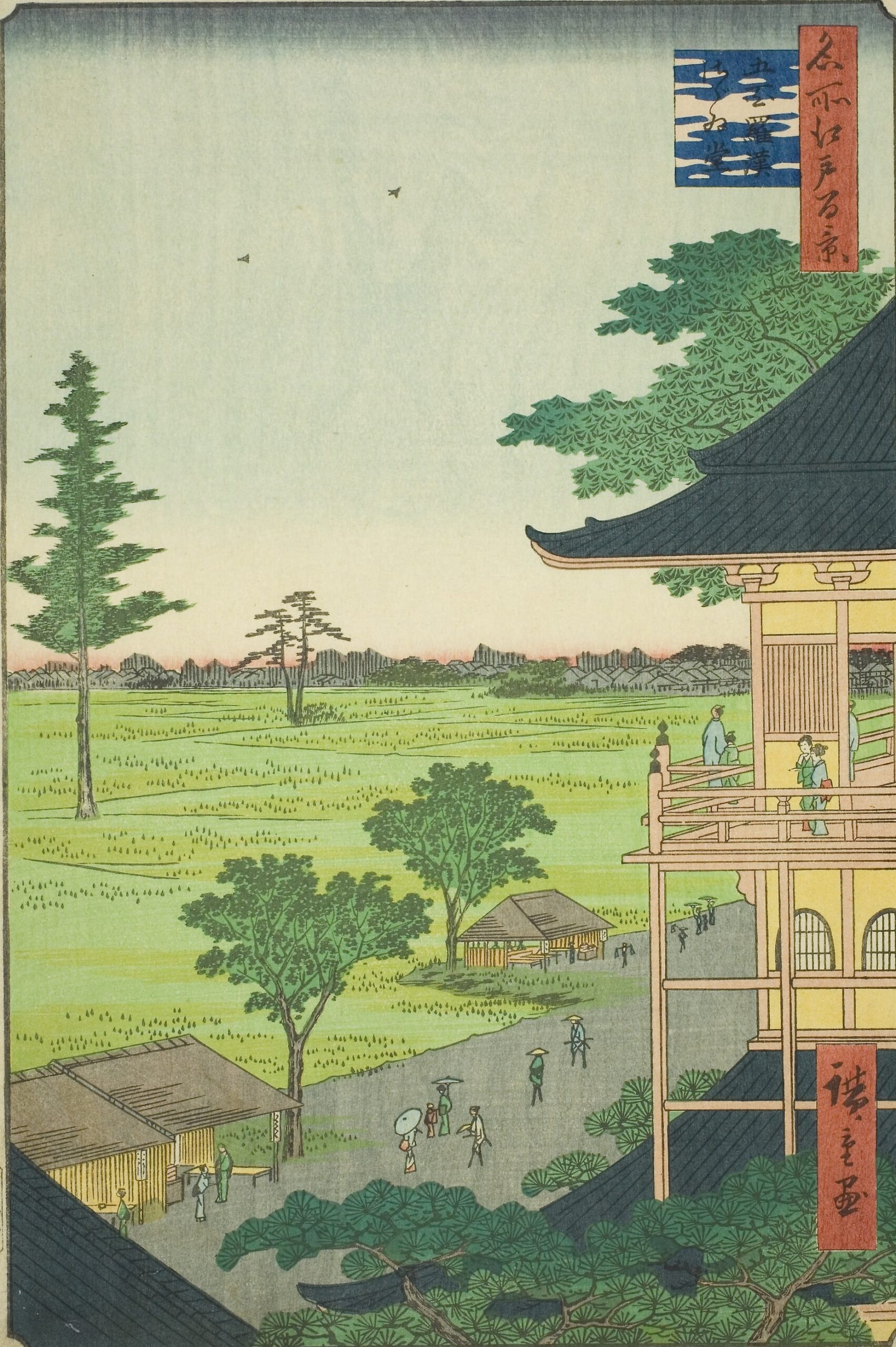
Utagawa Hiroshige – One Hundred Famous Views of Edo – 71 – Summer – 500 Arhats, Sazaido 歌川広重-名所江戸百景-71-夏-五百羅漢さゞゐ堂
Current Address: Asakusa Area, Taito Ward
Latitude and Longitude: Latitude: 35.7135, Longitude: 139.7960
Published: August 1857 Age: 61
Tourist Guide-Style Commentary: “500 Arhats, Sazaido”
■ Introduction
Utagawa Hiroshige’s “One Hundred Famous Views of Edo” is a large ukiyo-e series that vividly depicts the four seasons of Edo and the leisure activities of the common people.
“500 Arhats, Sazaido” focuses on the Gohyaku Rakan-ji Temple in Shitaya (present-day Taito Ward) and the “Sazaido” hall built within its grounds.
During the Edo period, the Gohyaku Rakan-ji Temple was a popular tourist destination, combining faith and entertainment.
With a Buddhist solemn atmosphere and unusual buildings and exhibits that commoners can enjoy, this is a place that satisfies both worship and sightseeing.
■ About the Gohyaku Rakan-ji Temple
Gohyaku Rakan-ji Temple was founded in 1691 by Zen Master Shoun Genkei, a disciple of Zen Master Tetsugen.
As its name suggests, the temple is home to over 500 arhat statues, attracting worshippers from all over Edo.
Each arhat statue has a different expression and appearance, and visitors could enjoy searching for an arhat that resembles themselves or an acquaintance.
As a result, the temple was not only a place of worship, but also a popular entertainment spot for the common people of Edo.
The temple is located near present-day Nishi-Asakusa in Taito Ward, Tokyo.
Its proximity to Ueno and Asakusa, making it easily integrated into Edo’s tourist routes, also contributed to its popularity.
■ About the Sazaido Hall
Sazaido Hall (Spiral Hall) is a rare building with a double helix structure.
The interior features a spiral passageway, designed to allow visitors to ascend and descend without ever having to return to their previous location.
The building was nicknamed “Sazaido” (Sazai Hall) because of its spiraling structure, reminiscent of a turban shell.
The hall houses paintings and statues depicting the life of Buddha and Buddhist tales.
Visitors could progress through the hall while following the stories.
This was like a “walking picture scroll,” combining religious experience with entertainment.
The unusual architectural structure and entertaining exhibits were well-received and became a highlight for pilgrims visiting Gohyaku Rakan-ji Temple.
■ Highlights of Hiroshige’s Paintings
Gohyaku Rakan-ji Temple was built in 1725 by the monk Zosen with funds raised from the city of Edo.
Sazaedo is a sub-temple of the temple, officially called Sanso-do, and was built in 1741.
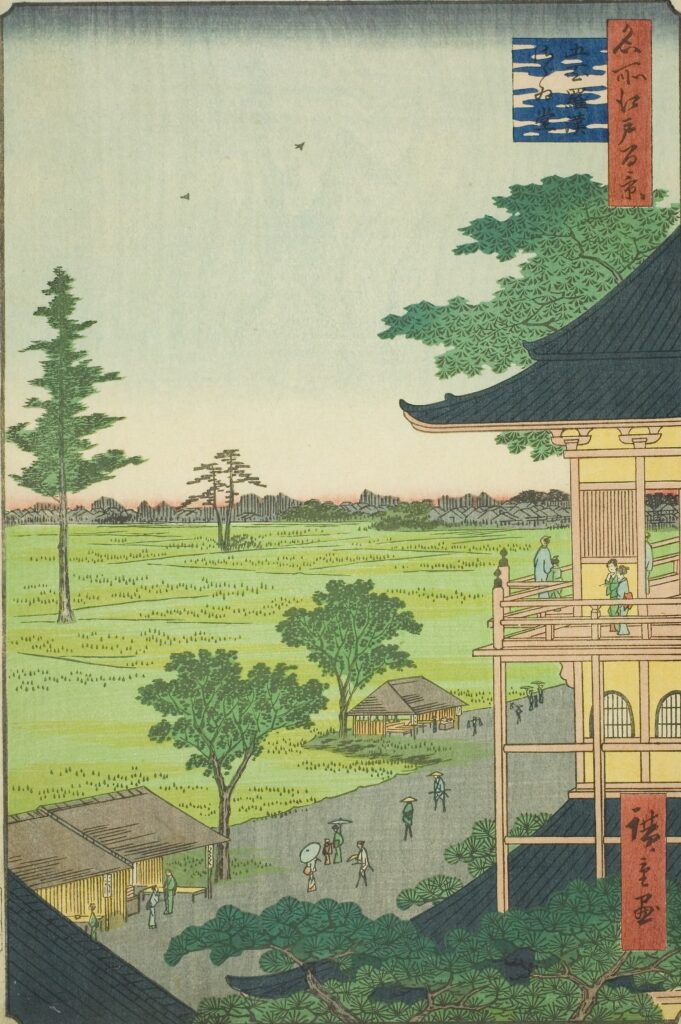
The image on the right shows the Sazaedo Hall. A teahouse roofed with reeds is visible on the lower left.
The Sazaedo Hall is a three-story building with a double spiral structure that descends from the top floor if you go around to the right.
A total of 100 Kannon statues are enshrined here, including the 33 statues on each floor and the one on the top floor.
Passing through here embodies the pilgrimage of Kannon statues: the first floor represents Chichibu, the second floor represents Bandō, and the third floor represents Saigoku.
The stage is about 10 meters high, and in the distance you can see the houses and lumberyards lining the Tatekawa River.
If you go left on the road in front of the Sazaedo Hall, you will come to the Onagi River.
■ Modern-day Gohyaku Rakan Temple
The current Gohyaku Rakan Temple was relocated from Taito Ward to Meguro Ward and rebuilt in Meguro.
The original Sazaedo Hall no longer exists.
The arhat statues and the temple’s history have been passed down to the present day. You can also experience the atmosphere at temples with similar architecture, such as the “Sazae-do” in Aizu-Wakamatsu.
■ Tourist Guide Recommendations
- Visit Meguro’s Gohyaku Rakan-ji Temple
The current Gohyaku Rakan-ji Temple is home to 305 arhat statues, allowing you to enjoy their expressions up close. - Aizu-Wakamatsu’s Sazaedo (Nationally Designated Important Cultural Property)
This is a representative surviving “Sazae-do” (turban hall).
It’s the perfect spot to experience the atmosphere of the spiral halls that were popular during the Edo period. - Comparative Sightseeing with Edo Culture
By visiting the temples and shrines around Ueno and Asakusa, you can experience Edo’s religious culture while walking around.