Utagawa Hiroshige – One Hundred Famous Views of Edo – 50 – Summer – Zojoji Temple Tower, Akabane (Red Wing) – Commentary 歌川広重-名所江戸百景-50-夏-増上寺塔赤羽根 解説
Current Address: Shibakoen 4-chome, Minato-ku, View of Mita 1-chome from Shibakoen
Latitude and Longitude: Latitude 35.6586: Longitude 139.7488
Published: January 1857 Age: 61
Commentary
<1> Introduction
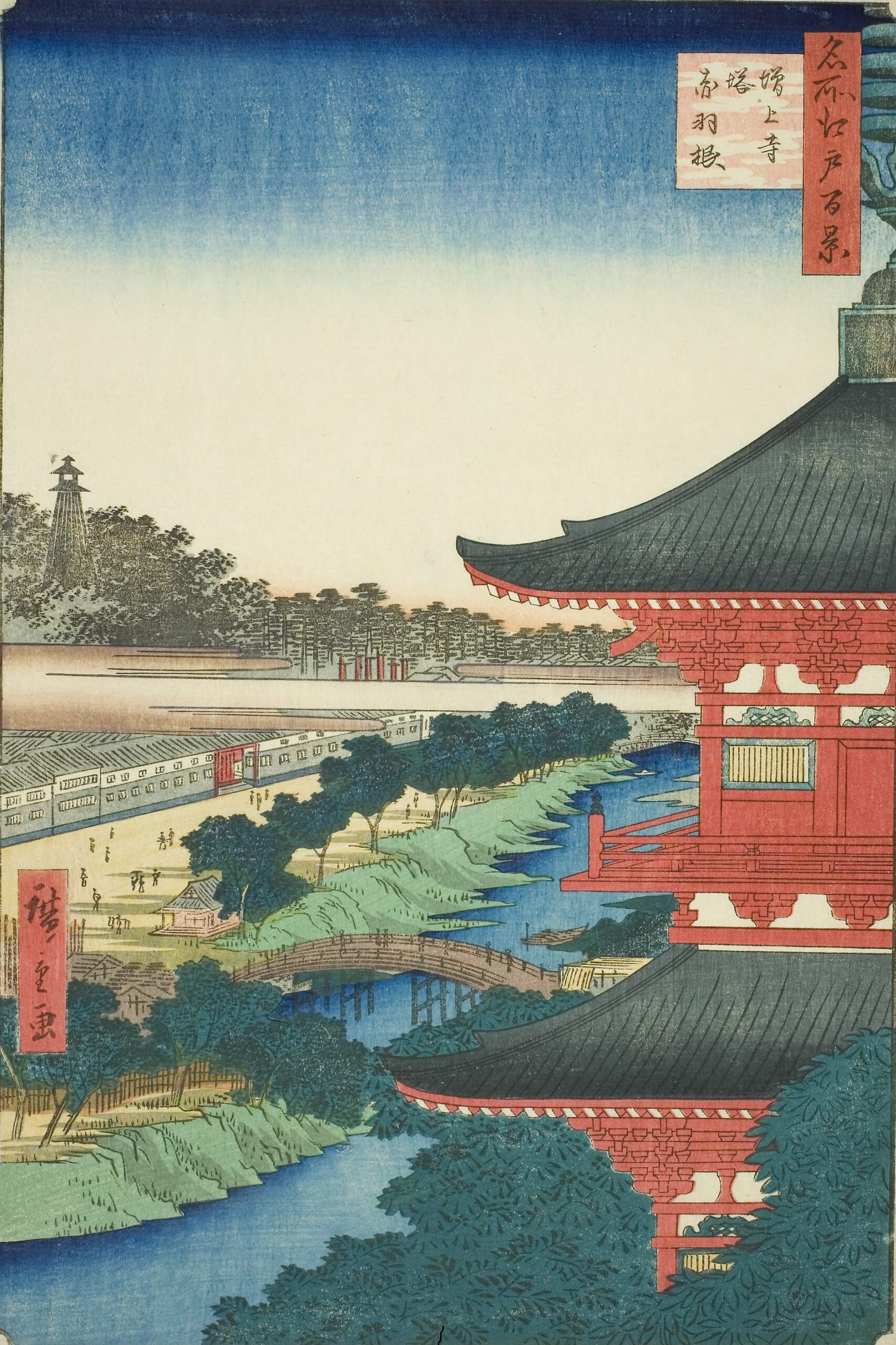
“Zojoji Temple Tower, Akabane” is a painting with the famous Zojoji Temple, one of Edo’s most famous temples, in the background.
It was a center of faith for Edo commoners and the Shogunate, and a famous spot for cherry blossoms and autumn leaves.
Zojoji Temple was a beloved tourist destination in Edo.
Hiroshige skillfully combines the majesty of the temple with the Edo landscape to create a work that evokes both faith and elegance.
<2> About Zojoji Temple and Akabane
Zojoji Temple is one of the seven main temples of the Jodo sect.
Originally founded in the Muromachi period, when Tokugawa Ieyasu entered Edo, he was a devout Jodo sect believer and it became the family temple of the Tokugawa family.
Subsequently, six successive shoguns have rested here, and the temple developed into a religious and cultural center of Edo.
The “tower” of Zojoji refers to the five-story pagoda built within the temple grounds.
The magnificent vermilion-lacquered tower was known as an Edo landmark and could be seen from far away.
To the Edoites of the time, the tower symbolized Zojoji.
“Akabane,” the title of the work, is the name of the area surrounding Zojoji.
This refers to the area stretching from present-day Shiba Park in Minato Ward to the Akabanebashi area, and during the Edo period it was lined with samurai residences and townhouses.
By combining the landscape of Akabane with the tower of Zojoji in the background, Hiroshige portrays the temple and the townscape as a unified whole.
<3> Highlights of the Painting
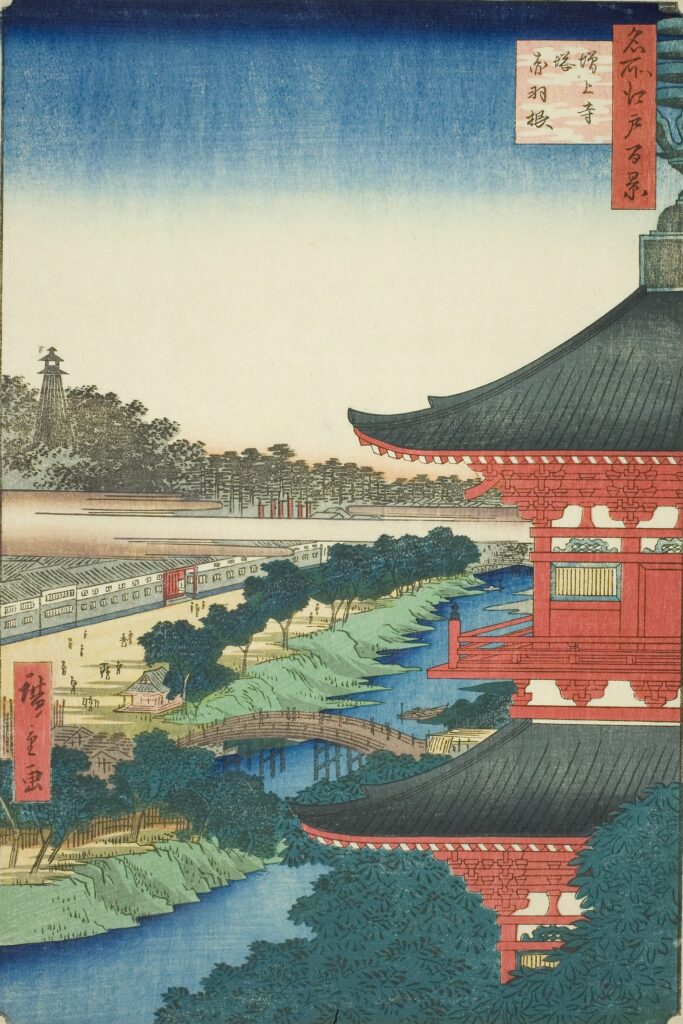
A shining vermilion five-story pagoda rises in the center of the painting.
Its appearance, standing out against the green trees and townscape, is truly one of the most representative landscapes of Edo.
While Zojoji Temple was a grand religious facility, it also coexisted with the living spaces of townspeople.
The painting also depicts people passing by, conveying that it was not only a place of worship, but also a place for strolling and recreation.
Hiroshige’s composition places the pagoda at the center, but also incorporates the expansive sky and distant mountain ranges. Even in the large city of Edo, you can enjoy a landscape in harmony with nature.
Zojoji Temple is a large temple with numerous historical sites within its vast grounds.
The large figure in the foreground is the five-story pagoda that once stood within its grounds.
It was built by Sakai Gagaku-no-kami, the lord of Himeji Castle, and was actually a historic six-story pagoda.
It was destroyed by war damage in 1945. Today, not even a trace of it can be seen.
Beyond the tower, the landscape of Akabane stretches out.
A fish market is held every morning at the north end of Akabane Bridge, which spans the Akabane River.
The market is represented by a reed-covered hut peeking out from behind the tower.
Across the bridge is the Tsujibansho, and on the opposite bank is the main residence of Arima Nakatsukasa Daifu of the Kurume domain.
Within the residence is a fire watchtower, once the tallest in Edo, used to guard Zojoji Temple.
It is depicted in a symmetrical position across the Akabane Bridge from the large five-story pagoda to the right.
A glimpse in the mist is the flag of Akabane Suitengu Shrine, which was located on the same property.
<4> Walking around modern-day Zojoji Temple
Current Zojoji Temple is located right next to Tokyo Tower.
You can enjoy a spectacular view that is different from that of the Edo period.
The temple grounds are home to the mausoleum of the Tokugawa Shogunate, making it a must-see for history buffs.
Cherry blossoms in spring and autumn leaves in autumn adorn the temple grounds, conveying their charm as a “cherry blossom viewing spot in Edo” to this day.
While the name Akabane no longer exists, the name remains in the place names “Akabanebashi” and the station name.
By strolling from Shiba Park to the Tokyo Tower area, following the setting of the story, you can experience the intersection of Edo and the present.
<5> Tourist Guide
1. Zojoji Temple Main Hall and the Tokugawa Shogun Mausoleum
A place where you can sense the dignity of the Tokugawa family and the history of their faith. The majestic structure of the mausoleum makes it perfect for historical exploration.
2. A View with Tokyo Tower
Zojoji Temple’s five-story pagoda no longer exists, but the view of Tokyo Tower over the main hall has become a popular “new tourist attraction.”
3. Akabanebashi Area
Although it is now a major transportation hub, you can enjoy a stroll searching for vestiges of the former “Akabane” area.