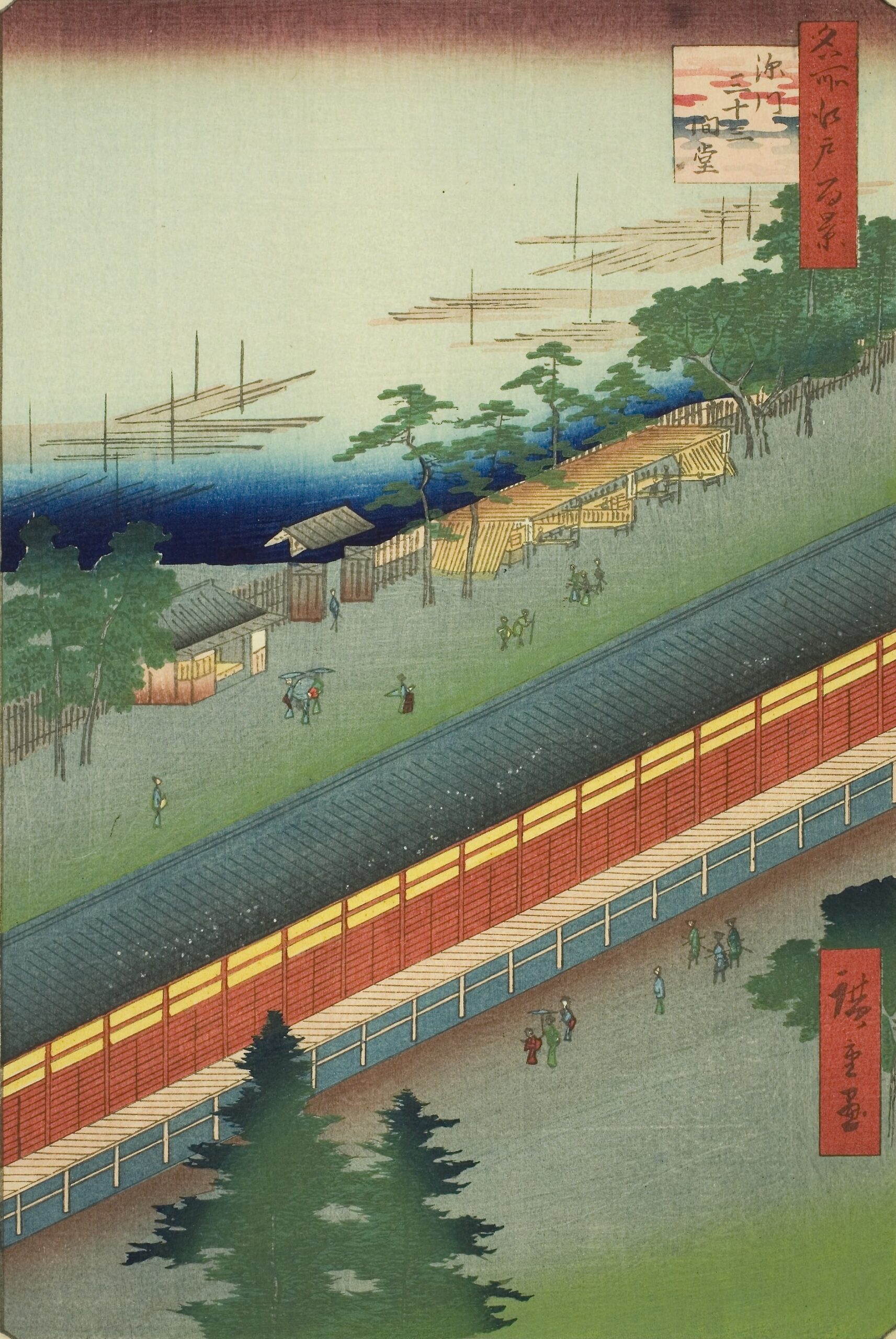
Utagawa Hiroshige – One Hundred Famous Views of Edo – 72 – Summer – Fukagawa Sanjusangendo Temple 歌川広重-名所江戸百景-72-夏-深川三十三間堂
Current Address: Near the Site of Sanjusangendo Temple, Koto Ward
Latitude and Longitude: Latitude: 35.6739, Longitude: 139.7965
Published: August 1857 Age: 61
Tourist Guide-Style Commentary: “Fukagawa Sanjusangendo Temple”
■ Introduction
Utagawa Hiroshige’s “One Hundred Famous Views of Edo” is a large-scale series depicting Edo’s famous sites through the changing seasons.
“Fukagawa Sanjusangendo Temple” is set in Fukagawa, which is now Koto Ward.
This temple was built in Edo in imitation of Sanjusangendo Temple (Rengeoin Temple) in Kyoto.
It was both a place of worship and a popular tourist spot for the people of Edo.
■ About Fukagawa Sanjusangendo
Fukagawa Sanjusangendo was built in the early Edo period, modeled after Sanjusangendo in Kyoto.
Sanjusangendo refers to a long Buddhist temple with 33 pillars. It houses a Thousand-Armed Kannon statue and attracted many pilgrims.
In addition to being a place of worship, the hall was also known as the stage for “Toshiya,” a competition of archery skills.
It was particularly popular as a New Year’s event, drawing large crowds and becoming a form of entertainment for the common people of Edo.
Although smaller than its Kyoto counterpart, it was a magnificent building for Edo, and its elongated form made it an eye-catching presence in the surrounding landscape.
■ Highlights of the Painting
Impersonating the Sanjusangendo at Rengeo-in Temple in Kyoto, the temple was originally built in Asakusa by the archer Bingo as a training ground for archery.
After it burned down in 1698, it was rebuilt near Fukagawa Tomioka Hachiman Shrine.
Later, it was toppled by a strong wind and rebuilt in 1828.
Though it housed the Thousand-Armed Kannon as its principal image, it appears that it had little religious significance.
Like the temple in Kyoto, it was long and narrow, measuring approximately 120 meters north to south and 7 meters east to west, and was surrounded on all sides by a veranda, in order to host the “Toshiya” (a type of archery) competition.
Toshiya was performed from the south end of the hall to the north end.
A competition was held to see who could shoot the most arrows over the course of a day and night.
The veranda on the west side, in the foreground of the image, is the stage, with spectators watching.
In “Edo Meisho Zue,” the main gate on the east side is depicted as the front.
This painting shows the west side, which is the back side.
The main theme of the painting is the original purpose of this temple, the Toshiya (a type of archery competition).
The temple, positioned at an angle on the screen, gives a sense of the speed of the arrows.
A lumber yard is depicted above, with a hanging teahouse next to it.
The composition is similar to that in the picture book “Edo Souvenirs.”
■ Fukagawa Sanjusangendo in Modern Times
Unfortunately, the Fukagawa Sanjusangendo that existed during the Edo period no longer exists.
It disappeared due to urban redevelopment after the Meiji era, as well as earthquakes and war damage.
However, Hiroshige’s ukiyo-e prints allow us to imagine its former bustle.
Today, the Fukagawa area is home to historic temples and shrines such as Tomioka Hachimangu Shrine and Fukagawa Fudodo Shrine, conveying the religious culture of Edo.
In addition, the Fukagawa Edo Museum features a recreation of the townscape of the time, allowing you to relive the atmosphere of the time when Fukagawa Sanjusangendo Shrine existed.
■ Tourist Guide Recommendations
- Visiting Tomioka Hachimangu Shrine
Like Fukagawa Sanjusangendo, Hachimangu Shrine was beloved by the people of Edo.
It remains bustling with activity today with its grand summer festival. - Fukagawa Fudodo Shrine
This temple shares similarities with Sanjusangendo Temple in that it enshrines the Thousand-Armed Kannon as its principal deity.
The goma fire ritual and the impressive main hall are must-sees.
3. Fukagawa Edo Museum
This museum features a life-size reproduction of the streets of Fukagawa during the Edo period.
This spot allows you to experience the world of ukiyo-e in three dimensions.
4. Monzen-Nakacho Gourmet Stroll
With many restaurants serving Edo-style cuisine, including Fukagawa meshi, this is the perfect place to end your visit to the shrine or sightseeing.