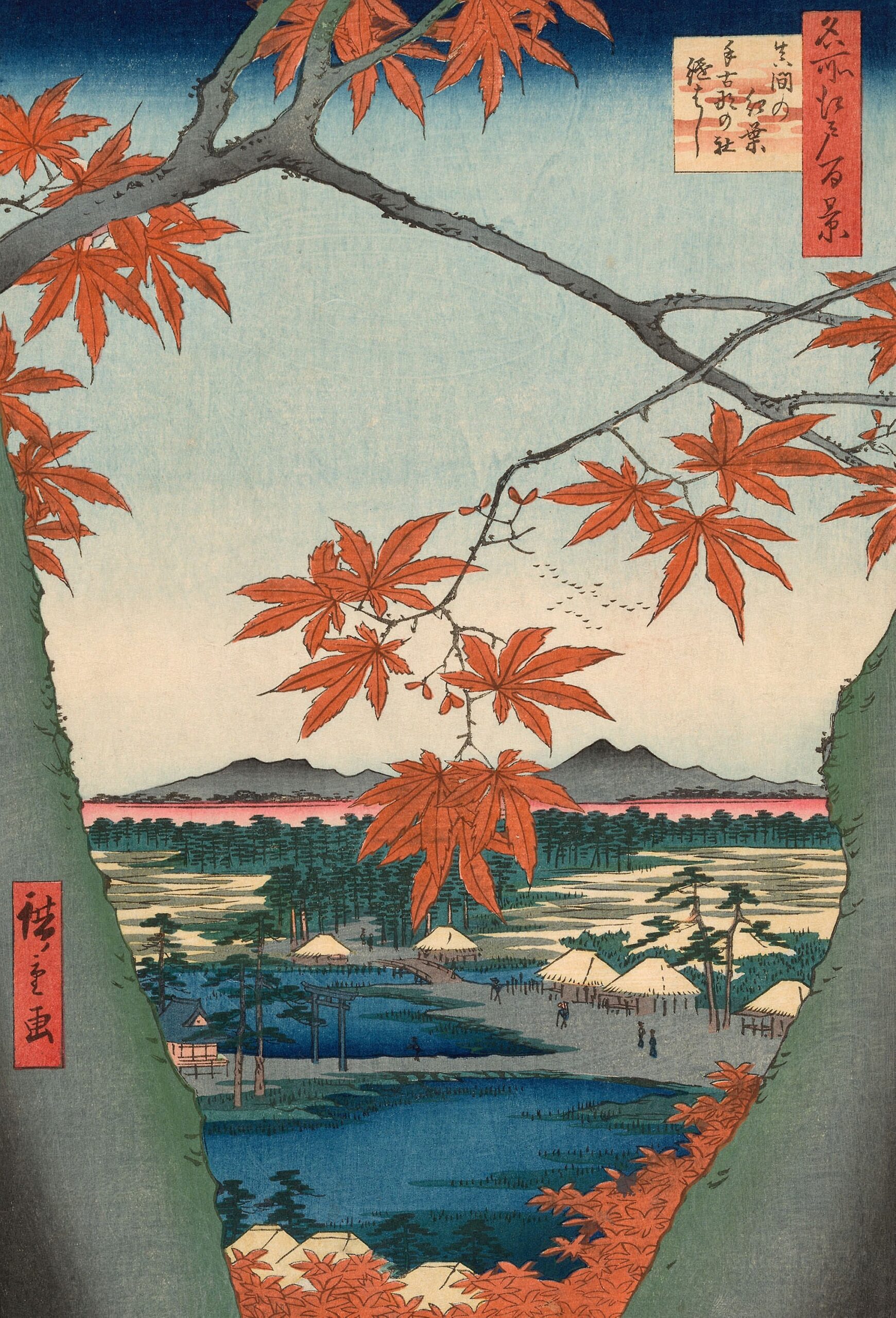
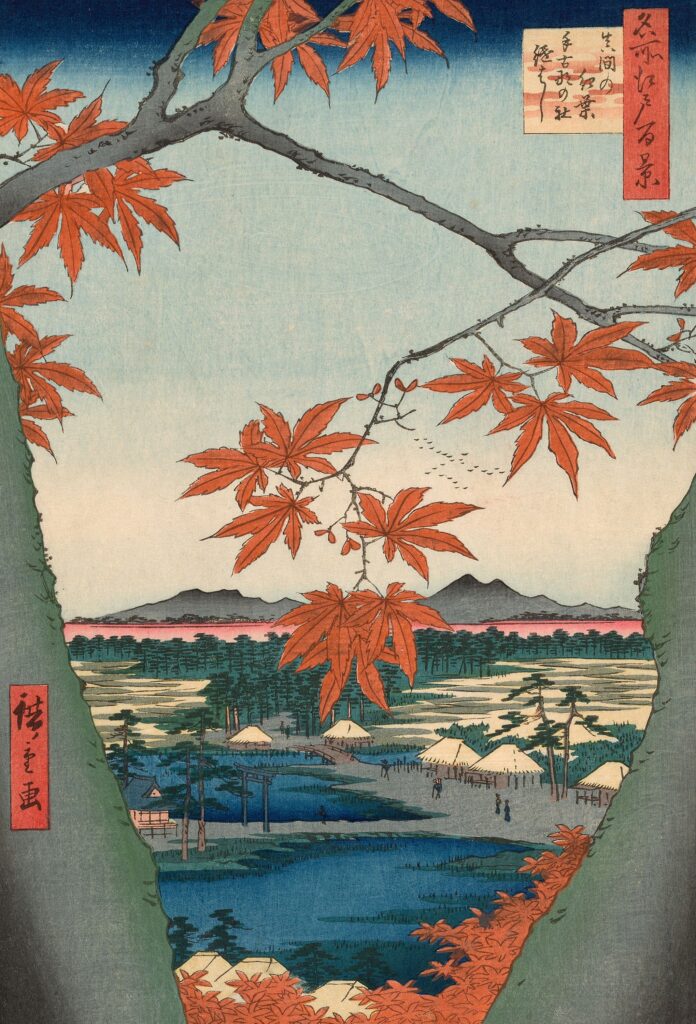
Utagawa Hiroshige-One Hundred Famous Views of Edo-95-Autumn-Autumn Leaves at Mama, Tekona Shrine Tsuguhashi Bridge 歌川広重-名所江戸百景-95-秋-真間の紅葉 手古那の社継はし
Current Address: Around Mamasan Guhoji Temple, Ichikawa City
Latitude and Longitude: Latitude: 35.7235, Longitude: 139.9185
Published: January 1857 Age: 61
Tourist Guide-Style Commentary: “Autumn Leaves at Mama, Tekona Shrine Tsuguhashi Bridge”
■ Introduction
Utagawa Hiroshige’s “One Hundred Famous Views of Edo” is a masterpiece series of ukiyo-e prints depicting the landscapes and seasonal colors of Edo and its surrounding areas.
Among them, “Autumn Leaves at Mama, Tekona Shrine Tsuguhashi Bridge” is set in Ichikawa, an area east of Edo.
Ichikawa Mama (present-day Ichikawa City, Chiba Prefecture) has long been a place of utamakura poetry, often cited as a source of inspiration for waka poetry. Its historic location, particularly the legend of Princess Tekona, is particularly well-known for its connection to the legend of Princess Tekona.
Hiroshige depicted the area as a famous spot for viewing autumn foliage, where visitors sought relaxation, while also capturing folklore, nature, and the leisure activities of ordinary people in a single painting.
Let’s explore the charm of Ichikawa Mama, a place steeped in history and legend despite its proximity to Edo through this work.
■ About Mama and Tekona Shrine
“Mama” has long appeared as a place name in utamakura poetry.
It is a famous spot dating back to ancient times, even appearing in the Manyoshu as “Mama no Tekona.”
The land stretches along the Mama River and has boasted scenic beauty since ancient times.
In the legend of Princess Tekona, Princess Tekona is a legendary beauty passed down in this area. In the Kokin Wakashu and the Manyoshu, Tekona was so beautiful that many men proposed to her.
It is said that she threw herself into the Mama Inlet to escape this trouble.
This tragic story has touched the hearts of generations to come, and Mama has been depicted in literature and paintings as a “place of pity.”
Based on this legend, Tekona Shrine was built in Mama.
Hiroshige’s painting depicts the grounds of Tekona Shrine and the surrounding autumn foliage.
In autumn, the leaves along the Mama River turn red, and, combined with the tragic tale of Princess Tekona, evoke deep emotions in travelers.
■ Highlights of the painting
Mama is located far east of the red line that defined the boundaries of Edo, on the east bank of the Edo River, which flows through Shimousa Province.
It has been a scenic spot known since the time of the Manyoshu.
It has also been famous since ancient times for its maple trees.
The Tsugibashi Bridge over the Mama Stream and other landmarks were featured in haiku and waka poetry even during the Edo period.
Hiroshige’s closest depiction is of the maple trees in the hilltop grounds of Kobo-ji Temple.
The small bridge depicted in the center of the landscape below is the Tsugibashi Bridge.
The torii gate and shrine on the left are Tekona Shrine.
■ Mama and Tekona Shrine Remaining Today
Today, Mama-san Kobo-ji Temple is still located in Mama, Ichikawa City, and the surrounding area is known as a famous spot for cherry blossoms and autumn leaves.
In particular, the vibrant autumn leaves in autumn are reminiscent of the world of ukiyo-e.
The Tekona Shrine itself remains as the Tekona Reijindo Hall within the Kobo-ji Temple grounds.
Visitors still pray here, reflecting on the legend of Princess Tekona.
Beautiful autumn leaves welcome visitors to the Kobo-ji Temple grounds and along the Mama River in autumn.
■ Tourist Guide Recommendations
- Visit Tekona Shrine
Visit the shrine, which tells the story of Princess Tekona, and experience the setting of an ukiyo-e firsthand. - Stroll along the Mama River
During the autumn foliage season, we recommend strolling along the riverside promenade and savoring the scenery depicted in Hiroshige’s paintings. - Stroll around Kobo-ji Temple and Ichikawa
Mamasan Kobo-ji Temple is a famous spot for cherry blossoms and autumn leaves, and you can enjoy the historic townscape while comparing it to the ukiyo-e.