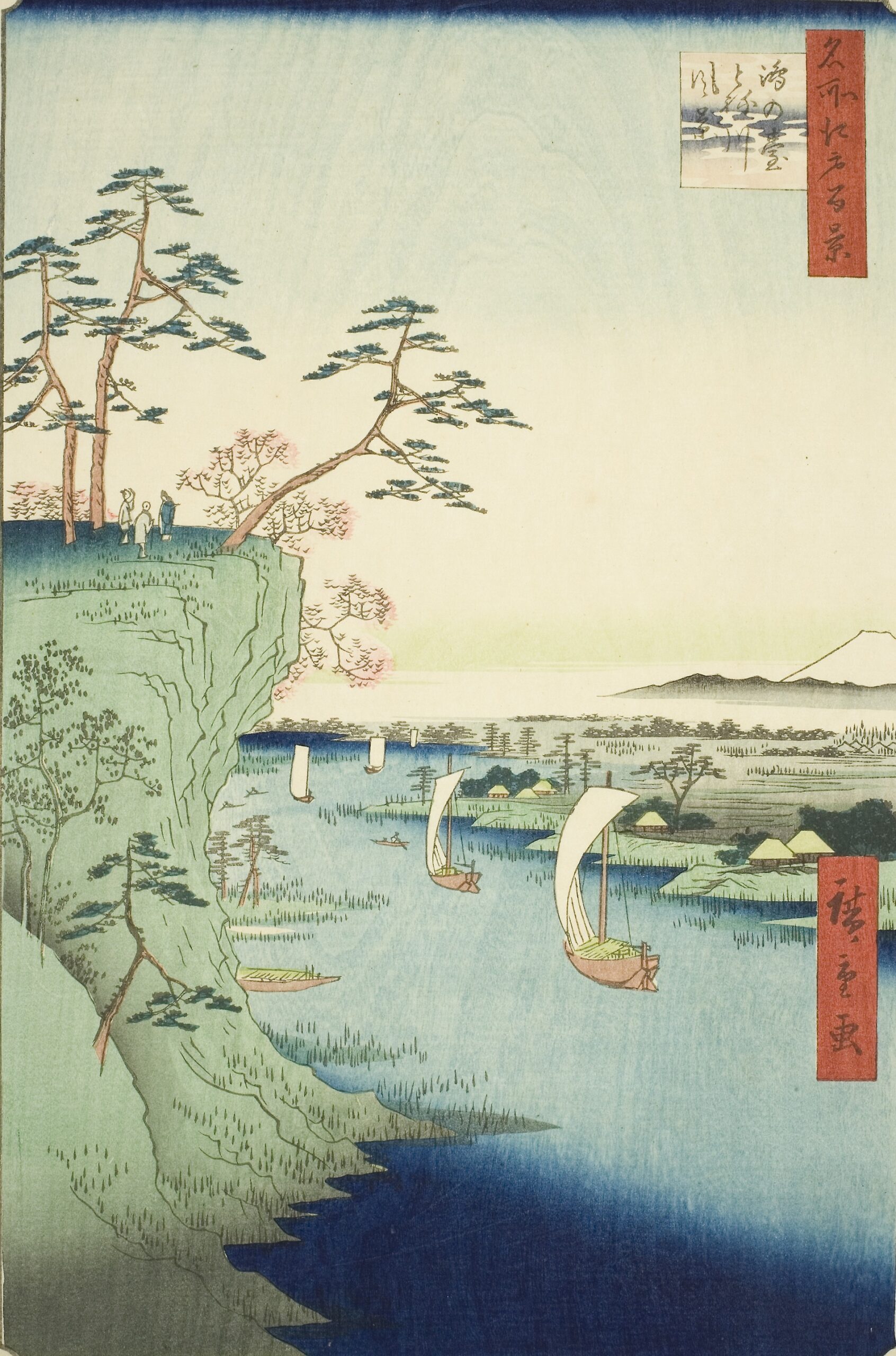
Utagawa Hiroshige-One Hundred Famous Views of Edo-96-Autumn-View of Konodai and the Tone River 歌川広重-名所江戸百景-96-秋-鴻の台とね川風景
Current Address: Kokufudai, Ichikawa City
Latitude and Longitude: Latitude: 35.7135, Longitude: 139.9030
Published: May 1856 Age: 60
Tourist Guide-Style Commentary: “View of Konodai and the Tone River”
■ Introduction
Utagawa Hiroshige’s “One Hundred Famous Views of Edo” is a large series of 119 paintings depicting Edo’s famous sites along with seasonal landscapes.
Among these, “View of Konodai and the Tone River” is a painting featuring the vast natural scenery northeast of Edo and the majestic flowing Tone River in the background.
While located far from the center of Edo, it was a perfect tourist destination for the common people of Edo, offering a taste of the “little travel romance.”
In this work, Hiroshige overlooks the Tone River from a hill known as Ko-no-dai, capturing its expansive expanse and natural beauty.
Unlike his works depicting the bustle of the city of Nihonbashi and Asakusa, this work is notable for its ability to capture the tranquility and grandeur of the Edo suburbs.
■ About Ko-no-dai
“Kou-no-dai” refers to a hill located in an area that straddles what is now Adachi Ward, Tokyo, and Soka City, Saitama Prefecture.
It was once a slightly elevated spot with a great view, offering views of the Tone River system.
The character “kou” (ko) is said to derive from the word for large bird, or “stork.”
This area was once home to vast wetlands, and many waterfowl such as cranes and storks flew there, which is said to be why the name “Kou-no-dai” came about.
Located along the highway heading north from Edo, its river traffic and rural scenery made it a popular destination for short trips near Edo.
The view from the elevated area was particularly popular, offering a panoramic view of the Tone River and the countryside, and allowing visitors to enjoy the changing seasons.
■ The Tone River’s Connection with Edo
Another main feature of “Kou-no-dai Tone River Landscape” is the Tone River.
The Tone River, also known as “Bando Taro,” is a major river that irrigates the Kanto Plain.
During the Edo period, the Tokugawa shogunate carried out large-scale river improvements to prevent flooding in Edo and to develop it as a major waterway.
The Tone River basin was a key transportation route for the prosperity of Edo, with rice, lumber, and other commodities transported throughout the city.
In the painting, boats float on the river, suggesting the flow of goods connecting Edo with the countryside.
For the common people, the Tone River was also linked to its magnificent natural beauty.
Waterside villages and farmland stretch along the river, allowing visitors to enjoy the richness of the four seasons: rape blossoms in spring, green rice fields in summer, and autumn leaves in fall.
■Highlights of the Image
Kou-no-dai is also written as Kokufudai or Kofudai.
It is a hill stretching from around Soneiji Temple to around Mama, overlooking the Tone River (now the Edogawa River).
In ancient times, it was the provincial capital of Shimousa Province, and in the Middle Ages, Satomi Yoshiaki built his castle here.
It was an important location as a fortress overlooking the direction of Musashi.
It is also the site where the Satomi clan was defeated in battle by the Hojo clan.
In the Edo period, the Satomi family served as the model for Kyokutei Bakin’s novel “Nansō Satomi Hakkenden.”
Soneiji Temple is home to zelkova trees and plum blossoms associated with Ota Dokan, as well as the graves of warriors associated with the Satomi clan.
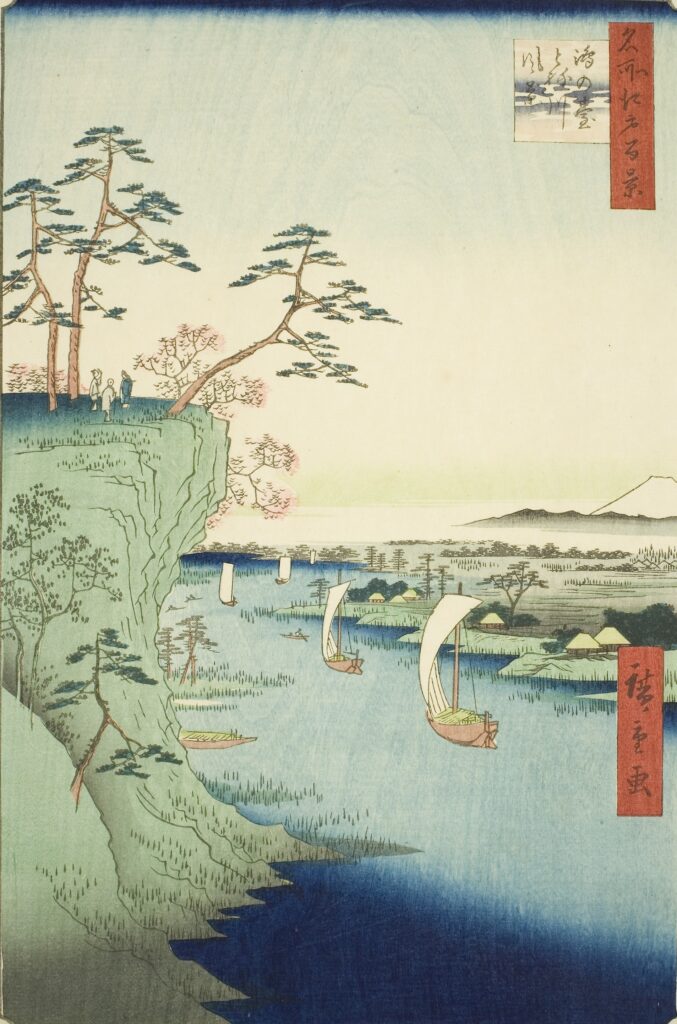
The hill on the left of the image is Kou-no-dai.
The flowing river is the Tone River.
Five Takase-bune boats can be seen.
Mount Fuji can be clearly seen in the distance to the right.
■ Landscapes Remaining in the Present
Currently, Adachi Ward and the surrounding areas of Ichikawa and Souka are rapidly urbanizing.
The Tone River basin still retains its spacious riverbed, developed into a cycling path and waterside park.
The landscape overlooking the river from high ground has changed dramatically.
Hiroshige’s depictions of the “majesty of the river” and “open sense of the sky” can still be felt today.
On the cycling path running along the Tone River, you can recall Hiroshige’s perspective while enjoying the modern-day “travel atmosphere of the Edo region.”
Remnants of post towns remain along the surrounding roads, allowing you to retrace the paths traveled by Edo-period travelers.
■ Tourist Guide Recommendations
① Stroll along the Tone River Riverbed
Experience the majestic waterscapes depicted by Hiroshige while walking along the vast riverbed.
② A Historical Stroll Around Edogawa and Souka-juku
Strolling through areas like Souka Matsubara, which retain the atmosphere of a post town, will give you a real Edo-era traveler’s feeling.
③ Visit a Literary Land
Since Konodai and the Tone River are featured in classical literature, we recommend exploring the area while imagining Hiroshige’s paintings and waka and haiku poems.