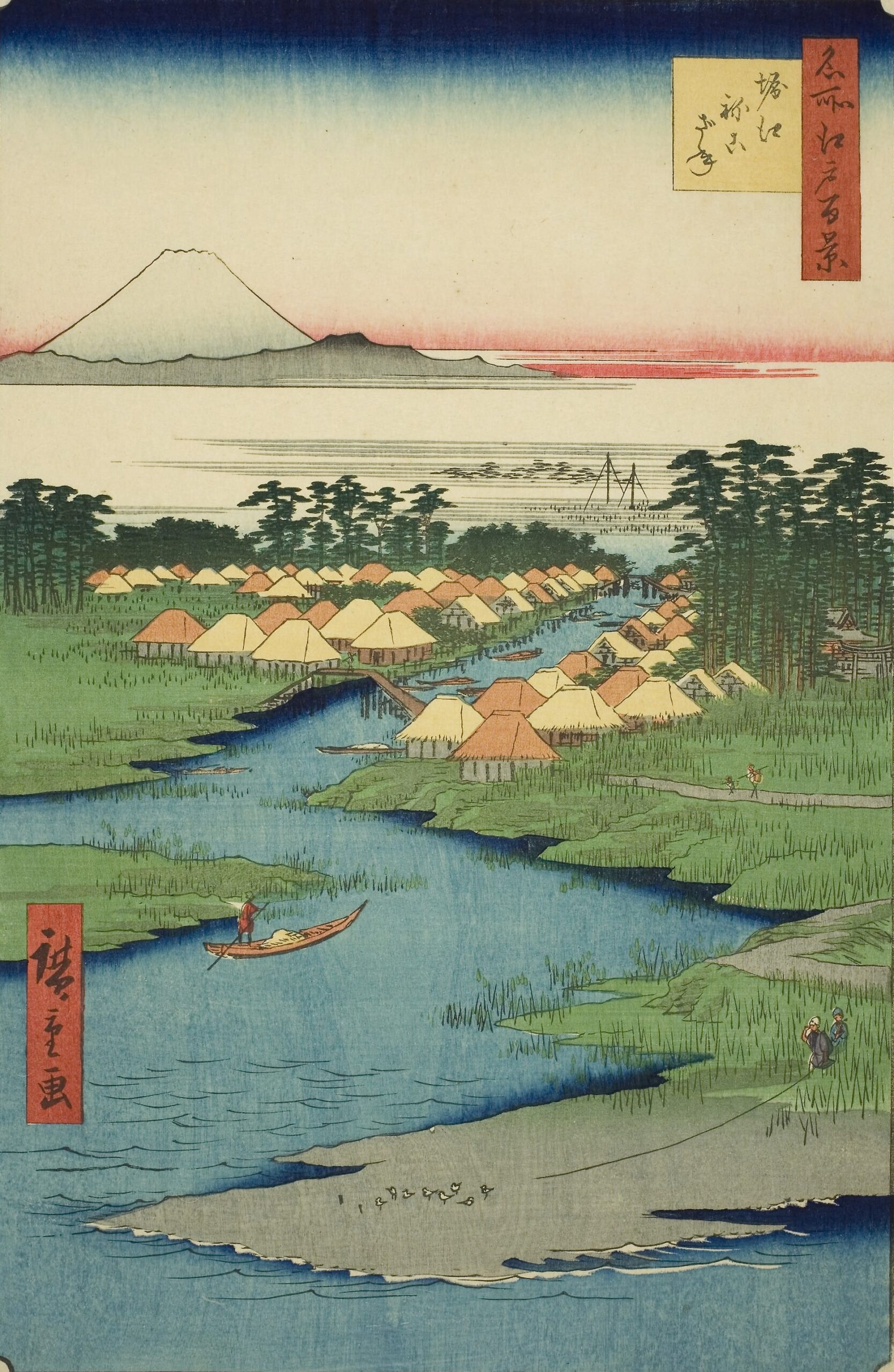
Utagawa Hiroshige-One Hundred Famous Views of Edo-97-Autumn-Horie Nekozane 歌川広重-名所江戸百景-97-秋-堀江ねこざね
Current Address: Horie/Nekozane, Urayasu City
Latitude and Longitude: Latitude: 35.6650, Longitude: 139.9030
Published: February 1856 Age: 60
Tourist Guide-Style Commentary: “Horie Nekozane”
■ Introduction
Utagawa Hiroshige’s “One Hundred Famous Views of Edo” is a series of ukiyo-e prints vividly depicting famous places in Edo and its surrounding areas.
This work, “Horie Nekozane,” depicts a fishing village east of Edo, in the area surrounding present-day Urayasu City, Chiba Prefecture.
This area, facing Edo Bay, was known as “Nekozane Village” at the time and was known for its fishing and seaweed farming.
Hiroshige captures the tranquil daily life of this fishing village, conveying a sense of seaside life and travel romance to the common people of Edo.
The charm of this rustic seaside landscape, far from the hustle and bustle of the city, lies in its simplicity.
■ Where is “Horie Nekozane”?
“Horie” refers to the Horie area of present-day Urayasu.
“Nekozane” is a place name that still remains in Urayasu City. Various theories suggest that it was named after the area, including that “cats were often caught there” or that it comes from the practice of catching fish while fishing.
During the Edo period, this fishing village, known as “Nekozane Village,” supplied Edomae seafood to the city of Edo.
It was within easy reach of Edo by boat heading toward Urayasu.
The seas around Edomae were rich, producing clams, cockles, seaweed, and whitebait, and Horie and Nekozane were one of these bases.
It was also a popular fishing village destination for common people, a popular short trip destination.
■ Highlights of the Painting
At the mouth of the Edogawa River, south of Konodai, the settlement on the right is Nekozane Village.
Toyouke Shrine can be seen to the right of Nekozane Village.
To the left is Horie Village, and the bridge in the foreground is Sakai Bridge.
Initially, to secure water and salt, the Tokugawa shogunate sourced water from the Tamagawa Aqueduct and Inokashira, and salt collected in the area and transported by digging a river.
Later, the area became known not only for its salt but also for its shellfish production.
People traveling from Konodai to Chiba would arrive here by boat and then walk.
It was a busy area.
Pictured in the foreground is a group of people hunting birds with a chidori-musou net.
The river in the foreground is the Sakai River.
■ Modern-day “Horie and Nekozane”
The place names “Horie” and “Nekozane” remain in present-day Urayasu City.
Although urbanization has progressed, traces of the past can be seen in the ancient alleys and shrines.
Toyouke Shrine (Nekozane), Kiyotaki Shrine (Horie), and Inari Shrine (Todaijima) are known as the “Urayasu Sansha” (Three Shrines of Urayasu) and convey the faith of this fishing village.
The annual festival is a traditional event that has continued since the Edo period.
At the Urayasu City Museum of History, you can see exhibits and fishing equipment that recreate Urayasu as a fishing village.
Right next to the glamorous tourist spots of Maihama and Tokyo Disney Resort, you can experience the history of the “fishing village of Urayasu” depicted by Hiroshige.
■ Recommended Tour Guide Course
- Urayasu City Museum of History
This permanent exhibition recreates the fishing village scenery of Horie and Nekomi from the Edo period, allowing you to enjoy linking Hiroshige’s ukiyo-e prints with local history. - Urayasu Sansha Tour
Visiting the “Urayasu Sansha” (Three Shrines of Urayasu)—Toyouke Shrine, Kiyotaki Shrine, and Inari Shrine—will allow you to experience the lifestyle and culture of the Edo period. - Stroll along the Old Edogawa River
Modern-day Horie and Nekomi stretch along the Edogawa River, and the landscape, surrounded by the river and the sea, has not changed much since then.
Walking along the embankments and waterfront parks, you can feel the remnants of the Edomae sea.